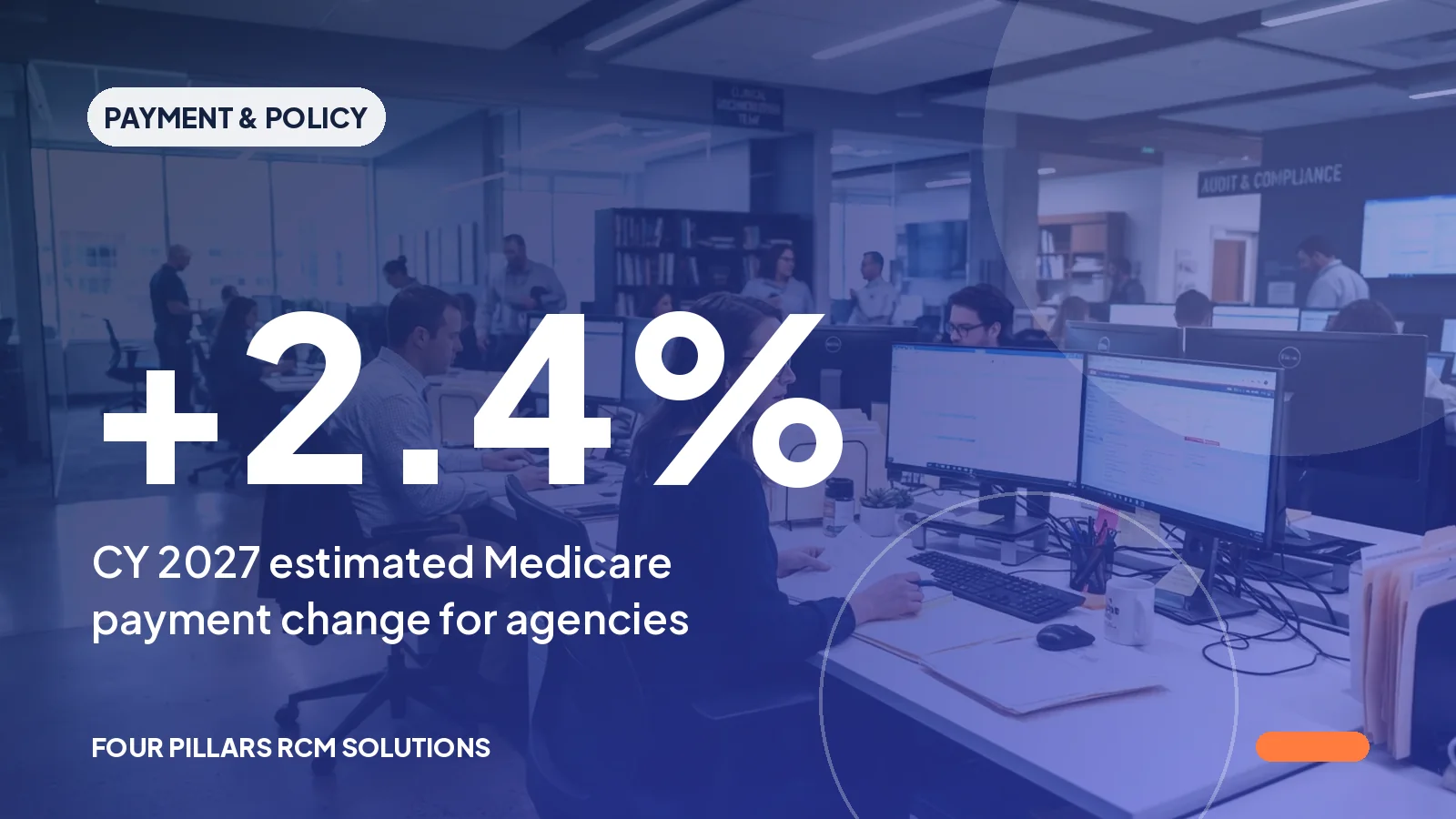
CMS estimates that CY 2027 Medicare payments to home health agencies will rise by 2.4% ($415 million) compared with CY 2026. The rule adds no new permanent behavioral adjustment, continues the 3.0% temporary reduction, and recalibrates PDGM case-mix weights, LUPA thresholds, functional impairment levels and comorbidity subgroups.
Key takeaways
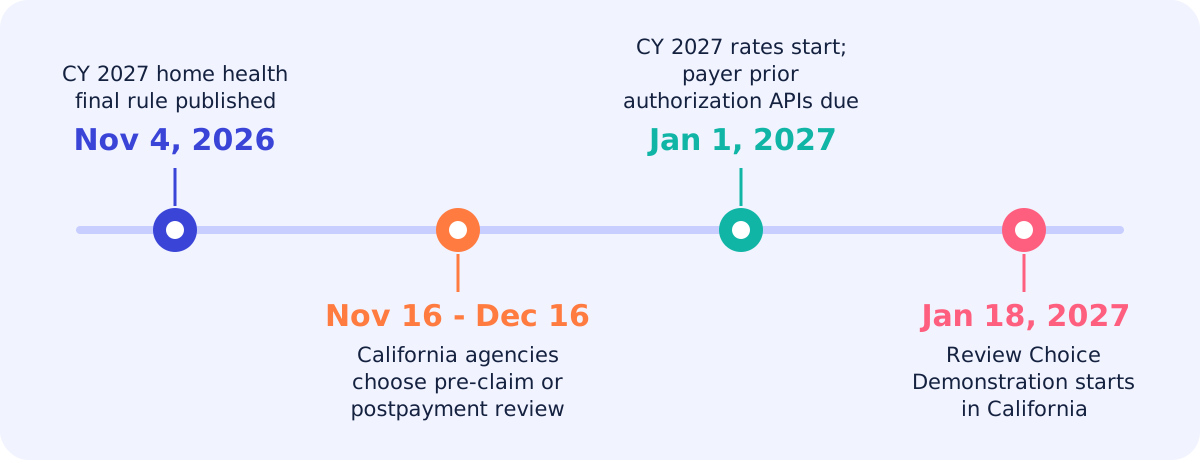
- CMS published the CY 2027 final rule (CMS-1844-F) on November 4, 2026; the new rates apply to 30-day periods beginning January 1, 2027.
- The estimated aggregate impact is +2.4% ($415 million): a 2.1% payment update plus 0.3% from the updated fixed dollar loss amount.
- No new permanent adjustment was finalized, but the 3.0% temporary reduction to the national standardized 30-day rate continues in 2027.
- PDGM case-mix weights, LUPA thresholds, functional impairment levels and comorbidity subgroups are recalibrated, so your own mix matters more than the headline.
On November 4, 2026, CMS published the Calendar Year 2027 Home Health Prospective Payment System final rule (CMS-1844-F). After a year in which agencies absorbed the first-ever temporary behavioral adjustment, the headline is better than many expected: an estimated 2.4% increase, no new permanent cut, and a mix of recalibrations that will help some agencies and hurt others. This article walks through what was finalized and what we would do between now and January 1.
What CMS finalized
CMS estimates that Medicare payments to home health agencies will increase by 2.4%, or about $415 million, in CY 2027 compared with CY 2026. The increase has two parts: a 2.1% payment update (about $365 million) and a 0.3% increase (about $50 million) from the updated fixed dollar loss (FDL) amount used for outlier payments.
| Item | CY 2026 final rule | CY 2027 final rule |
|---|---|---|
| Estimated aggregate impact | -1.3% (about -$220 million) | +2.4% (about +$415 million) |
| Permanent behavioral adjustment | -1.023% | None finalized |
| Temporary behavioral adjustment | -3.0% to the standardized 30-day rate | -3.0%, continuing |
| Fixed dollar loss (outliers) | n/a | Updated to 0.29% |
Sources: CMS fact sheets for the CY 2026 and CY 2027 final rules.
The 3.0% temporary reduction continues
CMS first used a temporary adjustment in CY 2026, alongside a smaller permanent adjustment of -1.023%. For CY 2027 it finalized no further permanent adjustment, but the -3.0% temporary reduction continues as CMS keeps recouping what it describes as overpayments from CY 2020 through CY 2025. That means the 2.4% headline is a net estimate: the temporary reduction is part of the baseline, not an extra cut on top. Plan your cash flow on the assumption that it stays in place for the full year.
Recalibration is where agencies will differ
The line item that deserves your attention is not the percentage but the recalibration. CMS finalized:
- Recalibrated PDGM case-mix weights, using CY 2025 data.
- Updated LUPA thresholds, functional impairment levels and comorbidity adjustment subgroups for CY 2027.
- An updated fixed dollar loss amount for outlier payments.
- Confirmation that CMS will provide sub-regulatory guidance on examples of home health palliative care services.
Case-mix weights decide how much each clinical group and functional level pays. When they are recalibrated, some of your most common admissions will gain and others will lose. Two agencies with the same census can see very different results.
A short video refresher on PDGM
If your clinical or intake teams need a refresher on how PDGM groups episodes, this overview video from an independent therapy provider is a good starting point. It is not CMS material, so check details against the rule itself.
A six-step checklist before January 1
- Re-run your last 12 months of admissions through the CY 2027 weights and thresholds. Compare by clinical group and functional level, not only in total.
- Find your LUPA exposure. With updated thresholds, episodes that were safely above the line may now sit near it. Review visit patterns on short episodes.
- Check comorbidity capture. Subgroup changes only help when secondary diagnoses are documented and coded with the right specificity. Our home health coding team looks at sequencing and comorbidity support on every chart.
- Protect functional scoring. Functional impairment levels depend on OASIS answers that match the clinical record. An OASIS review before billing catches the inconsistencies that cost agencies money and invite audits.
- Update billing system rate tables and test claims on a sample before the first January episodes close. See our medical billing and RCM service if you want a second check on claim scrubbing and denial handling.
- Model cash flow with the 3.0% reduction in place, including Medicare Advantage mix, which does not always follow the fee-for-service schedule.
Three agency profiles, three different questions
Therapy-heavy agencies should look first at LUPA thresholds and functional impairment levels, because visit mix drives both. Comorbidity-rich agencies (cardiac, diabetes, wound care) should model the revised comorbidity subgroups against their actual secondary diagnoses. Agencies with high Medicare Advantage census should remember that fee-for-service rates often anchor contract negotiations, so a favorable schedule may open a conversation with plans, while an unfavorable one is a reason to review contracts early.
A month-by-month plan
| When | What to do |
|---|---|
| November | Read the final rule summary, pull 12 months of episodes, and run the first impact model. |
| December | Fix the findings: documentation gaps, comorbidity capture, functional scoring, LUPA-risk admissions. Update billing system tables. |
| January | Watch the first 30-day periods closely: grouping, claim edits and payment against your model. Correct early. |
What we are telling agencies
A better headline rate is welcome, but it will not fix documentation problems. Agencies that enter 2027 with clean, consistent charts, accurate comorbidity coding and tight functional scoring will capture the benefit of the recalibration. Agencies that do not will see it leak away in downcoded episodes, denials and audit recoupments. Our process is built around exactly that: review before the claim goes out, not after.
Want a second pair of eyes on your charts? Book a free consultation or request a demo and our team will walk through your workflow with you.
This article summarizes CMS publications as of November 2026 and is not legal or financial advice. Always confirm details against the final rule and your Medicare Administrative Contractor.
Frequently asked questions
When do the CY 2027 home health rates take effect?
Does a 2.4% increase mean every agency gets 2.4% more?
What is the 3.0% temporary reduction?

Four Pillars Revenue Cycle Desk
Our revenue cycle desk writes about billing, denials, prior authorization and cash flow for home health and hospice agencies, based on the daily work of our billers and utilization coordinators.