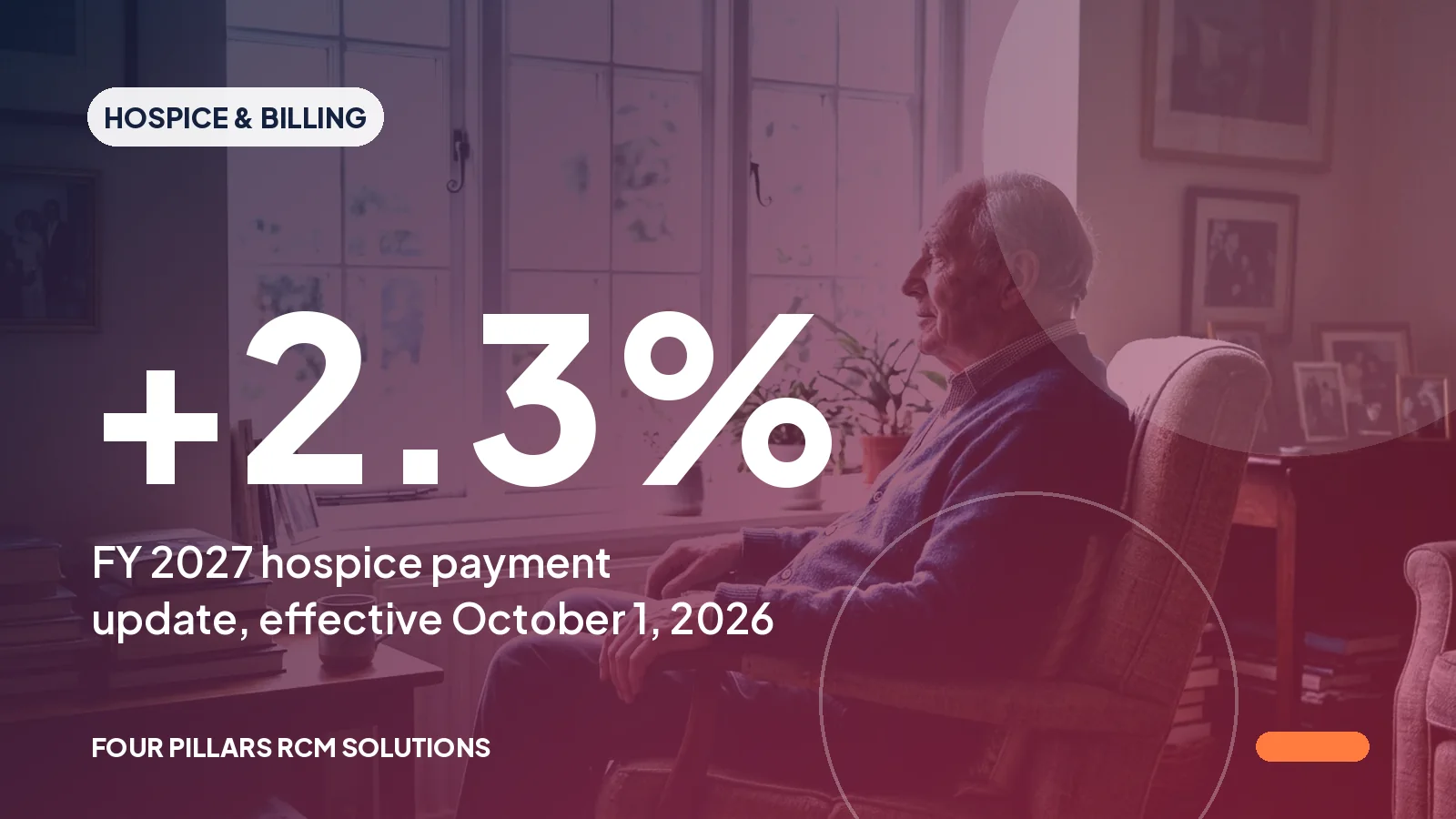
For FY 2027 (October 1, 2026 to September 30, 2027) CMS updated hospice payment rates by 2.3%, set the aggregate cap at $36,174.75, and kept the 5% cap on wage index decreases at the county level. Hospices that do not submit required quality data receive the 2.3% update minus 4 percentage points, a -1.7% change.
Key takeaways
- The FY 2027 hospice payment update is 2.3% (a 3.2% market basket update reduced by a 0.9 point productivity adjustment).
- The FY 2027 aggregate cap is $36,174.75, up from $35,361.44 in FY 2026; the cap year runs October 1, 2026 to September 30, 2027.
- Hospices that miss quality reporting requirements receive the 2.3% update minus 4 percentage points, which is -1.7%.
- The permanent 5% cap on wage index decreases continues at the county level for FY 2027.
The hospice fiscal year began on October 1, 2026, and with it came the annual update to payment rates, the aggregate cap and the wage index. CMS's billing instruction for the update is MM14557. This summary covers the pieces billing and coding teams should act on.
The key numbers
| Item | FY 2027 |
|---|---|
| Payment update | 2.3% (3.2% inpatient hospital market basket update minus a 0.9 point productivity adjustment) |
| Update for hospices that do not submit required quality data | -1.7% (2.3% minus 4 percentage points) |
| Aggregate cap amount | $36,174.75 (FY 2026: $35,361.44) |
| Cap year | October 1, 2026 to September 30, 2027 |
| Rates effective for care provided | October 1, 2026 to September 30, 2027 |
CMS also continues the permanent 5% cap on decreases to a geographic area's wage index, calculated at the county level, and keeps the special 50xxx wage index treatment for counties affected by the transition. The inpatient cap is calculated from the percentage of all hospice days provided as inpatient days, including general inpatient and respite care.
Why the quality reporting line matters
A 4 percentage point penalty turns a 2.3% increase into a 1.7% reduction for every claim for the year. It is easy to treat quality reporting as a clinical or compliance task separate from revenue, but the arithmetic makes it a billing issue. Confirm that your quality data submissions are complete and on time, and make someone responsible for checking the confirmation.
A billing and coding checklist for the new year
- Load the FY 2027 rates and the updated hospice pricer in your billing system, and test claims that span October 1.
- Refresh your coding tools. The FY 2027 ICD-10-CM code set also took effect on October 1, 2026; confirm that your encoder and edits are current and that deleted codes are replaced with the right alternatives.
- Monitor your cap position for the new cap year, starting with the aggregate cap of $36,174.75 and your inpatient day mix.
- Check wage index assignments for each patient location, especially in counties under the 5% transition cap.
- Verify certification and recertification documents before billing, because missing signatures and late certifications are the most common causes of hospice claim problems.
- Reconcile NOE, NOTR and claims so admissions, revocations and transfers match what you bill.
- Schedule a quality reporting check before the next submission deadline.

Three hospice billing problems to avoid
- Late Notice of Election. An NOE that is not filed within five calendar days of the admission date can leave the days before filing non-covered. Build a daily check into admissions.
- Certification gaps. A missing or late physician certification or recertification, or a missing face-to-face encounter for later benefit periods, can sink a claim. Verify them before billing.
- Level-of-care mismatches. Documentation has to support every change between routine, continuous, respite and general inpatient care.
Where we can help
Our certified coders handle hospice coding and palliative reviews inside your EMR (see home health and hospice coding), and our billing team covers claim scrubbing, denials and aged AR in medical billing and RCM. If you want an independent look at a sample of recent hospice charts, our quality assurance review gives you a second-level audit before your next claim run.
Want a second pair of eyes on your charts? Book a free consultation or request a demo and our team will walk through your workflow with you.
Figures are from CMS billing instruction MM14557 and the FY 2027 hospice final rule as of October 2026. Confirm details with your Medicare Administrative Contractor.
Frequently asked questions
When do the FY 2027 hospice rates apply?
How is the FY 2027 hospice cap calculated?
What is the penalty for not reporting quality data?

Four Pillars Coding & OASIS Desk
Our coding and OASIS desk writes about ICD-10-CM, PDGM grouping and OASIS accuracy. The team includes coders and reviewers with credentials such as BCHH-C, CPC, OASIS COQ-S, COS-C and HCS-O.