

The home health Review Choice Demonstration (RCD) is active in Illinois, Ohio, Oklahoma, North Carolina, Florida and Texas, and CMS will extend it to California for billing periods beginning on or after January 18, 2027. Agencies choose pre-claim review or postpayment review, and aim for a 90% affirmation or approval rate to earn more choices.
Key takeaways
- RCD currently applies to home health agencies in Illinois, Ohio, Oklahoma, North Carolina, Florida and Texas.
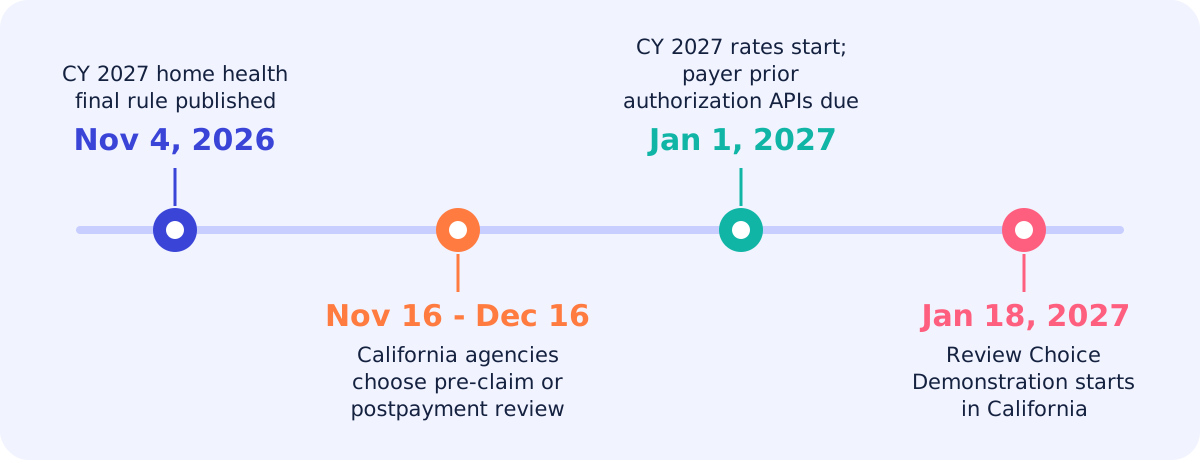
- California agencies choose between pre-claim review and postpayment review; the demonstration starts for billing periods on or after January 18, 2027, with a selection window from November 16 to December 16, 2026.
- An agency that does not choose defaults to postpayment review.
- Reaching a 90% target affirmation or approval rate is what earns an agency more review choices, so packet quality matters from the first claim.
Since the Review Choice Demonstration (RCD) began, home health agencies in the participating states have had to think about documentation before they bill. In late October 2026 CMS confirmed that California is next. If you operate there, or in any RCD state, this guide explains how the options work and how to get your packets approved the first time. The CMS reference page is here.
Where RCD applies in 2026 and 2027
The demonstration currently covers home health agencies in Illinois, Ohio, Oklahoma, North Carolina, Florida and Texas. CMS has announced that it will begin in California for billing periods on or after January 18, 2027, with a selection period running from November 16 to December 16, 2026. Palmetto GBA runs monthly provider webinars on the demonstration, and agencies should confirm contractor-specific rules with their own MAC.
Your review choices
California agencies choose between two initial options:
- Pre-claim review (PCR): every claim is reviewed before it is billed, and the agency gets a provisional affirmation or a non-affirmation.
- Postpayment review: claims are billed as usual and reviewed afterward, which means recoupment risk if documentation does not hold up.
An agency that does not choose defaults to postpayment review. Whichever option you pick, performance counts: after an agency reaches the target affirmation or approval rate (CMS uses 90%, based on a minimum number of requests or claims), it becomes eligible for additional review choices, including relief from claim-by-claim review apart from spot checks.
Watch an update from the field
This briefing from an independent healthcare consultancy summarizes how the demonstration works. It is not CMS material.
What a strong PCR packet contains
Affirmation rates are earned in the packet, not at submission. We build and check each one against this list:
| Document | What reviewers look for |
|---|---|
| Physician orders and certification | Signed, dated, timely, and matching the plan of care |
| Face-to-face encounter | Timely, structured, and tied to the primary reason for home health |
| OASIS (SOC, ROC, recertification) | Answers that agree with the clinical notes and support the diagnoses and functional levels |
| Plan of care | Medical necessity, visit frequency and duration, measurable goals |
| Therapy evaluations and nursing notes | Skilled need and homebound status documented |
| Diagnosis and HCPCS coding | Correct sequencing and specificity |
Five habits that protect your affirmation rate
- Review before you submit. A non-affirmation costs days. Catch missing signatures, mismatched frequencies and weak face-to-face notes first.
- Submit complete packets through the right portal and keep a log of dates and determinations.
- Track affirmative and non-affirmative responses daily and route deficiencies to the right clinician the same day.
- Rework and resubmit fast. The reason code tells you what is missing, so fix it once and fix it well.
- Watch NOA and timeliness. Notice of Admission and submission deadlines are easy to miss during busy admissions.
If your state is not in the demonstration yet
RCD has grown state by state, and California shows that CMS is willing to extend it quickly where it sees risk. Agencies elsewhere do not need to wait. Building packet discipline now (orders, face-to-face, OASIS and plan of care reviewed together) costs little, pays back in fewer audit findings, and means you are ready if your state is announced.
A working plan for California agencies
| Window | Action |
|---|---|
| Now to November 16 | Audit a sample of recent charts against the packet table above. Decide who owns submission and response tracking. |
| November 16 to December 16 | Make and confirm your initial review choice in the selection window, remembering that no choice means postpayment review. |
| December to January 18 | Train clinicians on the weak spots you found, rehearse the submission workflow, and prepare templates for rework requests. |
| From January 18 | Monitor your affirmation or approval rate weekly and review every non-affirmation for patterns. |
How we support agencies
Our PCR and pre-claim authorization service covers every step above: eligibility review, documentation compliance checks, packet preparation and portal submission, response monitoring, rework and resubmission, and NOA oversight. It works alongside our plan of care review and OASIS review, so the documents in your packet agree with each other before a reviewer sees them.
Want a second pair of eyes on your charts? Book a free consultation or request a demo and our team will walk through your workflow with you.
Dates reflect CMS and trade-press announcements as of November 2026. Confirm timelines and rules with CMS and your Medicare Administrative Contractor.
Frequently asked questions
What is pre-claim review?
What happens if a California agency does not make a choice?
What do agencies need to hit the 90% target?

Four Pillars Quality & Compliance Desk
Our quality and compliance desk writes about audits, pre-claim review, survey readiness and documentation integrity, drawing on RN QA specialists and clinical reviewers.